English Spelling Check: How to Check English Spelling Online
Find likely typos, choose British or American English deliberately, and decide whether a suggested correction fits your sentence.


What an English Spelling Check Actually Checks
An English spelling check compares words with a language dictionary and patterns. It is useful for finding likely errors, but it is not a vote on your ideas or a guarantee that every accepted word is correct.
A good first pass can catch a missing letter, an extra letter, a transposed pair, or a word that is close to the intended form. It can also flag a word that belongs to another language or a form that does not match the selected dictionary. The longer the text, the more helpful it is to check one sentence at a time when a suggestion seems uncertain.
Spelling and grammar overlap, but they are different jobs. The words their, there, and they’re are all spelled correctly; the sentence decides which one belongs. The same is true for affect and effect, advice and advise, or practice and practise. An English spelling check can point at the location, while a context-aware review helps you make the final choice.
Names, product labels, code terms, URLs, quotations, and regional words may be correct even when a dictionary does not recognize them. Add approved terms to a personal dictionary when your editor supports it, or keep a short list beside your project. Do not weaken a sentence simply to remove every underline.
| Check type | Example | What the writer decides |
|---|---|---|
| Typo or missing letter | recieve -> receive | Accept the correction if the sentence means receive. |
| Word form | seperate -> separate | Confirm the intended word before replacing it. |
| Homophone | their / there / they’re | Use grammar and meaning, not the underline alone. |
| Regional variant | colour / color | Follow the audience or house style consistently. |
| Specialized term | APIName or product model | Keep it when it is an approved proper term. |
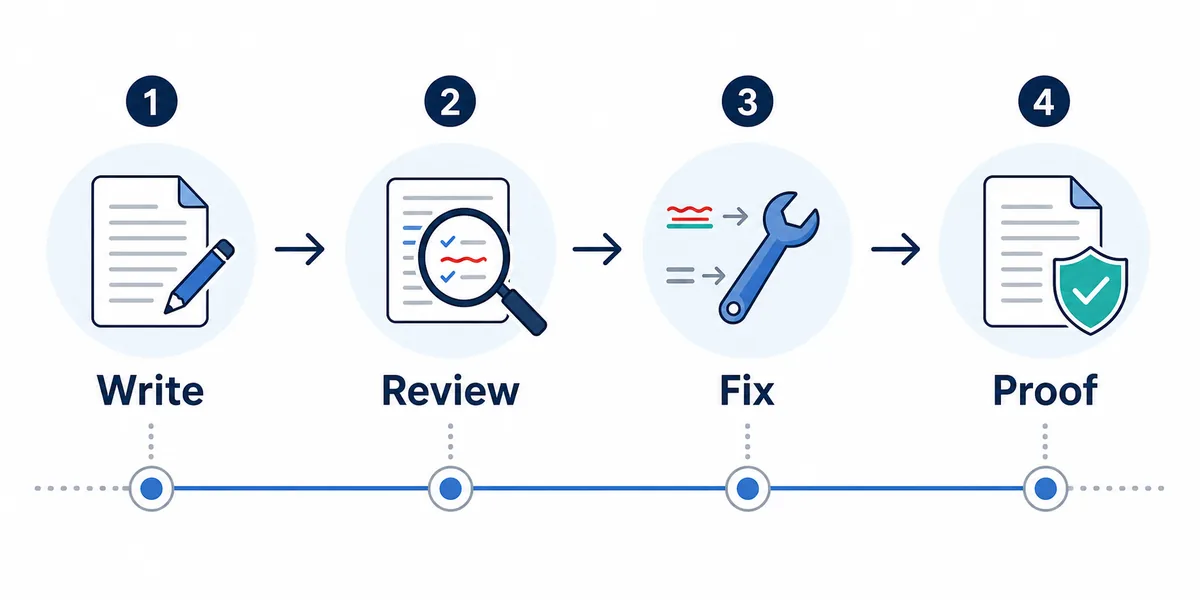
A Reliable Five-Step English Spelling Check
Use the same short sequence for an email, assignment, application, or document so that a checker supports your judgment instead of replacing it.
- 1. Finish a readable draft Write enough context for a sentence to make sense. Checking isolated words can hide homophones and word-choice errors.
- 2. Select English and the intended variety Choose English, then British, American, Australian, or another available variety when the editor offers that choice. Keep the selection consistent.
- 3. Run the spelling check Paste or type the text, wait for underlines or a result list, and use the exact sentence around each flagged word to understand the suggestion.
- 4. Review one suggestion at a time Accept a replacement only when it preserves the meaning, tense, name, number, and tone you intended. Ignore a false positive and record a recurring term.
- 5. Read the clean version aloud Look again for names, dates, numbers, links, and repeated words. A final read catches errors that a dictionary cannot infer.
For a quick test, use a sentence with a clear mistake such as “I recieved the revised file yesterday.” If the tool suggests receive, compare the corrected sentence with the original meaning before accepting it. Then remove the test sentence and check the real draft. A visible result is evidence that the process ran, not evidence that every sentence is ready.
If you are reviewing a long document, split the work into passes. Start with spelling, then check grammar and punctuation, then make a style pass. Changing several categories at once makes it harder to tell whether a suggestion fixed a typo or introduced a new tone or meaning.
Keep the source version until you finish. In a shared document, use tracked changes or a copy so that a questionable replacement can be compared with the original. This is especially useful when an editor changes a technical term, a quoted phrase, or a name.
For a document-focused workflow, open the Word spell check guideafter this general English spelling check.
British and American Spelling Differences
British and American English share the same core language, but a checker may flag a valid regional form when its dictionary is set to another variety. Consistency matters more than pretending that one accepted variety is the only correct option.
The pairs in the table are examples, not a complete conversion rule. Some words are shared, some have accepted alternatives, and some depend on whether a word is a noun or a verb. A spelling checker should help you notice a difference; it cannot know whether your university, employer, client, or publisher has a preferred style unless you set that style yourself.
If your draft is for a British audience, choose a British dictionary and keep forms such as colour, centre, and travelling consistent. For a US audience, American forms such as color, center, and traveling may be expected. If the audience is international, follow the style guide and avoid switching varieties mid-document.
A regional flag is not automatically an error. Treat it as a prompt to check the audience, the dictionary, and the rest of the document. When a source quote or proper name uses a different variety, preserve the original and explain the choice only when your format requires it.
| Pattern | British English | American English | Practical check |
|---|---|---|---|
| -our / -or | colour, behaviour | color, behavior | Match the publication or audience. |
| -re / -er | centre, theatre | center, theater | Check the house style before changing it. |
| -ise / -ize | organise or organize, depending on guide | organize | Do not assume every British guide uses -ise. |
| -ce / -se | licence (noun), license (verb) | license | Confirm the part of speech in the sentence. |
| individual words | grey, jewellery, programme | gray, jewelry, program | Use a dictionary for the exact word and context. |
Common English Spelling Traps
Many errors repeat because English spelling reflects word history, pronunciation changes, and exceptions. Learning a few patterns makes the next English spelling check faster.
Build a personal list from your own mistakes. A short list of ten words that you repeatedly misspell is more useful than a long list you never revisit. Add the correct form, a short sentence, and a note about the pattern or meaning that makes the word memorable.
Vowels and the ie/ei pattern
Words such as believe, receive, and piece are often remembered with an ie/ei rule, but the rule has exceptions. Use it as a prompt, not a guarantee. When you are unsure, check the whole word in a trusted dictionary rather than relying on pronunciation alone.
- receive, ceiling, and deceive use ei after c in common examples.
- believe, niece, and field use ie in common examples.
- Weird, foreign, and seize show why a dictionary still matters.
Double consonants and suffixes
Adding -ing, -ed, or -er can change a final consonant: stop becomes stopped, and plan becomes planning. The exact pattern depends on syllable stress, the final letters, and the variety of English. A checker can flag a form, but a learner benefits from keeping the base word and suffix together.
- Separate, necessary, and accommodation are useful words to memorize.
- Check whether a final consonant is doubled before adding a suffix.
- Do not infer a spelling from sound when the word has an unstressed vowel.
Homophones and near-homophones
Their, there, and they’re; your and you’re; and its and it’s are common because the spoken forms are similar. Read the sentence and expand the contraction when possible. If the expanded phrase does not make sense, the contraction may be wrong.
- Use their for possession and there for a place or existence.
- Use your for possession and you’re for you are.
- Use its for possession and it’s for it is or it has.
How to Choose a Checker and Read Suggestions
An English spelling checker is useful when its output is clear, its language setting is visible, and its limitations are easy to understand.
For a short email, you may only need a browser or editor dictionary with underlines and one-click suggestions. For an essay or report, look for a complete result view, readable explanations, and a way to review the original sentence. If a tool hides the text it changed or mixes spelling with rewriting, you may need a second pass to confirm what happened.
Prefer a checker that tells you which language variety it uses. A result that marks colour as wrong may be perfectly reasonable if the tool is set to American English. Conversely, a checker set to British English may not be the right choice for a US application. The setting is part of the result, not a minor preference.
Treat confidence labels and suggestions as clues. A high-confidence typo such as recieve is easy to correct; a suggestion involving a name, a technical term, or a homophone deserves a slower read. Keep a dictionary or style guide nearby for decisions that affect a formal submission.
Before pasting confidential text, review the product's privacy explanation and your organisation's policy. Avoid passwords, private identifiers, client records, and unpublished material unless the approved workflow explicitly permits the service.
- Visible language and regional settings
- Suggestions shown in the full sentence
- A clear way to ignore or undo a change
- Privacy information that matches your use case
- Support for personal or technical vocabulary
A Practice Routine for Learning English Spelling
If your goal is to learn English spelling rather than only remove today’s typos, turn each check into a small retrieval exercise.
- Collect a small weekly list Choose five to ten words from your own writing. Include the wrong form, the correct form, and one sentence that shows the meaning.
- Group words by a visible pattern Put words such as receive, deceive, and ceiling together, or group regional pairs such as colour and color. Patterns are easier to recall when they have examples.
- Recall before looking Cover the correct spelling and write it from memory. Then check it with a dictionary or English spelling checker and note the reason for any error.
- Reuse the word in a new sentence A new sentence proves that you remember the meaning as well as the letter order. Revisit the list after a few days instead of repeating it immediately.
Pronunciation can help, but it is not a complete spelling guide. English includes silent letters, borrowed words, and vowel patterns that sound alike. Read the word, say it slowly, and look for a related word family: sign and signal, heal and health, or explain and explanation can reveal letters that disappear in casual speech.
Reading also supplies repeated examples. When you notice a word in a reliable book, lesson, or professional document, copy the sentence and compare it with your own use. Pay attention to the noun, verb, adjective, and plural forms rather than memorizing one isolated spelling.
A checker can provide immediate feedback, but learning happens when you predict, check, explain, and retrieve the word later. That four-part routine is more durable than accepting a replacement without noticing why it was needed.
Limits, Privacy, and the Final Human Review
No English spelling check can infer every intention from letters alone. Use automated suggestions for speed, then reserve the final decision for a person who understands the message.
A checker may accept a correctly spelled word that is wrong for the sentence, miss a new name, or suggest an unfamiliar variant. It may also flag a word because the selected dictionary does not include a technical term. These are normal limits of dictionary and pattern-based checks, not proof that the tool is broken.
For important text, read once for meaning and once for mechanics. Confirm names, numbers, dates, links, file names, quotations, and the spelling of every organisation or product. Compare the final draft with the source if a tool changed several words at once.
Keep private information out of unapproved online checkers. A short public example is enough to test an interface; a confidential contract, medical note, password, or customer list is not. Follow your school or workplace policy and delete test text when you finish.
The best result is a consistent, understandable document for its audience. An English spelling check supports that goal, but it should never override a correct regional form, a deliberate voice, or a verified proper name.
Final review habit
Accept a suggestion only after it makes sense in the entire sentence, matches the intended English variety, and preserves the writer’s meaning.
English Spelling Check FAQ
How do I check English spelling online?
Paste a complete sentence or paragraph into an English spelling checker, select British or American English when available, review each suggestion in context, and read the final text yourself. A clear result helps you find likely typos, but it does not decide homophones, names, or regional style for you.
What is the difference between an English spelling check and a grammar check?
A spelling check focuses on letter forms and likely misspellings. A grammar check looks at relationships such as agreement, tense, word choice, and sentence structure. They overlap for words such as their and there, so read the sentence instead of accepting an isolated replacement.
Should I use British or American spelling?
Use the variety required by your audience, course, employer, publisher, or house style. Neither colour nor color is automatically wrong. Choose a matching dictionary and keep the choice consistent across the document.
Why does a spelling checker flag a correct word?
The word may be a name, technical term, regional form, new product label, or a valid word missing from the selected dictionary. Check the language setting and context, then ignore or add the term when your editor supports a personal dictionary.
Can an English spelling checker find every mistake?
No. It can miss correctly spelled but misused words, new names, numbers, links, and meaning errors. Use the suggestions as a first pass and complete a human review for important writing.
How can I learn English spelling faster?
Keep a short list of words you actually misspell, group them by patterns, recall the spelling before looking, and reuse each word in a new sentence after a few days. This turns an English spelling check into practice rather than a one-time correction.