Spellcheck Francais: How to Check French Spelling Online
A practical guide to accents, grammar, punctuation, language settings, and a careful final read.


What Does Spellcheck Francais Mean?
Spellcheck francais is a common unaccented way to search for a French spell checker. The correctly accented language name is français, but people often type francais when their keyboard is set to English or when they are searching quickly.
The useful result is not just a list of red underlines. A dependable French spelling check should look at the word, the sentence around it, and the language setting that produced the suggestion. French writing can lose meaning when an accent disappears, when a noun and adjective disagree, or when a correctly spelled homophone is used in the wrong sentence.
Use a checker as a first pass for typos, missing accents, repeated letters, agreement errors, and punctuation. Then decide whether each suggestion matches your intended meaning. A person, place, product name, quotation, address, or technical term may be correct even when a dictionary does not recognize it.
For the working checker, open the French spell checkerand paste a sentence, email, or document excerpt.
What a French Spelling Check Should Review
French proofreading is broader than asking whether every word appears in a dictionary. These checks cover the mistakes that most often survive a quick typing pass.
Start with visible typing errors, but do not stop there. A checker can identify a missing accent more consistently when the sentence gives enough context. It may be uncertain with one isolated word, especially when two spellings are both real French words. Paste a complete sentence or paragraph when you want a meaningful grammar and word-choice review.
French also has regional and editorial variation. A form accepted in France may appear differently in Canadian, Belgian, or Swiss writing, and the 1990 spelling reforms allow some traditional and revised forms to coexist. If a suggestion changes a familiar word, compare the proposed form with the style guide or audience you are writing for rather than assuming that the newest-looking form is always required.
| Check | Example | Why it matters |
|---|---|---|
| Spelling | mesage -> message | A missing letter can make a familiar word look correct at a glance. |
| Accents | recu -> reçu; a -> à | An accent can change pronunciation, grammar, or meaning. |
| Agreement | il vont -> ils vont | The subject and verb need to agree in number and person. |
| Word choice | ou -> où; son -> sont | A valid word can still be wrong for the sentence. |
| Punctuation | quotation marks, apostrophes, commas | Punctuation separates ideas and affects readability. |
| Casing | français, lundi, Paris | Names, nationalities, and sentence starts follow different conventions. |
- Paste enough context for homophones and agreement rules to be evaluated.
- Keep a personal dictionary or approved name list for specialized vocabulary.
- Review the original and corrected sentence together before copying changes.
French Accents, Cedillas, and Similar Words
Accents are part of French spelling, not optional decoration. They can signal pronunciation, distinguish words, and make a sentence easier to interpret.
Common accent families
The acute accent appears in words such as été and café. The grave accent appears in à, où, and many forms with è. The circumflex appears in words such as forêt and sûr. The diaeresis helps show that adjacent vowels are pronounced separately, as in naïf, while the cedilla turns c into ç before a, o, or u in words such as français and leçon.
- Acute: é, as in été.
- Grave: à, è, ù, as in à and où.
- Circumflex: â, ê, î, ô, û, as in forêt.
- Diaeresis: ë, ï, ü, as in naïf.
Homophones need sentence context
French has many pairs that sound similar but perform different jobs. C'est and s'est, ces and ses, on and ont, and son and sont are examples. A spelling dictionary may accept both members of a pair, so the final decision depends on grammar and meaning. Read the subject, verb, and surrounding nouns before changing a word.
Set the French Proofing Language Before You Check
A checker can only make a useful language decision when it knows which language rules to apply. Use this short setup sequence in Word, Gmail, Google Docs, or another editor.
- Choose French Open the document, message, or checker language menu and choose the French variant that matches your audience when one is available.
- Test a plain sentence Type one short sentence with an obvious typo such as Je recu votre message, then wait for a suggestion or run the manual check.
- Check the input method If accents are missing as you type, review the keyboard layout or use the editor's character menu. Do not blame the proofing language for an input problem.
- Separate mixed-language text Mark English quotations, names, URLs, and code as exceptions or review them separately so French rules do not create noisy suggestions.
Language settings differ by product and version, but the diagnostic idea is stable: compare one clean French sentence with the text that is causing trouble. If the test sentence is checked correctly, the original issue may be a name, a copied formatting marker, mixed language, or a valid alternative spelling. If nothing is checked, verify the language and the editor's spell-check setting before changing the text.
A Reliable Spellcheck Francais Workflow
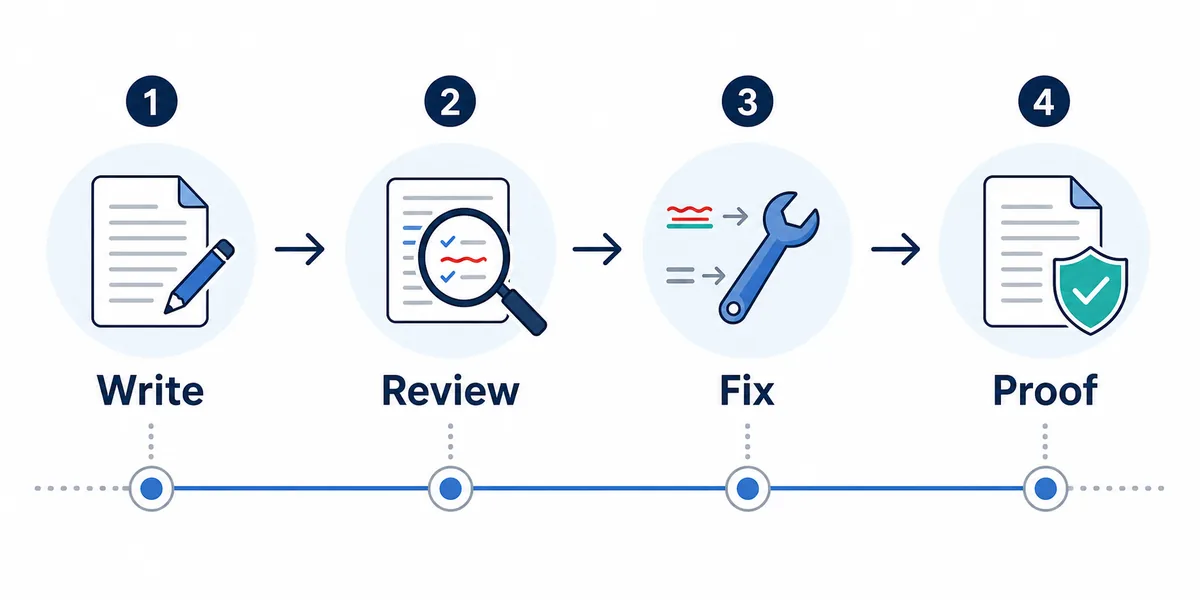
A repeatable workflow helps you catch both obvious typos and the errors that require context. Use it for an email, assignment, report, or translated passage.
- Draft without interrupting every sentence Finish the thought first. Constantly accepting suggestions while drafting can hide a larger meaning or structure problem.
- Run a French spelling pass Check missing letters, repeated letters, accents, apostrophes, hyphens, and common keyboard slips.
- Run grammar and agreement checks Review subject-verb agreement, gender, plural forms, tense, and sentence boundaries in context.
- Inspect names and numbers manually Confirm people, places, dates, prices, links, order numbers, and technical terms against the original source.
The order matters. Start with the text you intend to say, then let a checker surface likely issues, and only after that make editorial decisions. If you accept every suggestion during drafting, you may lose a deliberate word or introduce a change that sounds correct but changes the meaning.
For a long document, work in sections and keep a short list of approved terms. A list prevents the checker from repeatedly flagging a company name, course title, product feature, or specialist noun. When the audience expects a specific regional variety of French, keep the same convention throughout the document.
When the draft is ready for a separate pass, use the French spell checker tooland compare its suggestions with the original text.
Practical takeaway
The best spellcheck francais routine combines language-aware suggestions with a human decision about meaning, names, regional spelling, and the reader's expectations.
What a French Spell Checker Cannot Decide
Automated corrections are helpful signals, but they do not establish that a French text is accurate, appropriate, or true.
A spell checker may miss a correctly spelled wrong word, especially with homophones, names, and short sentences. It may also flag a new product name, local place, acronym, or technical term that you want to keep. Grammar suggestions can be conservative, and punctuation preferences may depend on the publisher, school, country, or style guide.
Meaning and facts remain your responsibility. Check dates, amounts, addresses, quotations, links, citations, and instructions against the original source. Read the final French text as a reader would, not only as a list of accepted suggestions.
Privacy matters too. Use a checker only with text that your workplace, school, client, or personal policy allows you to process. Remove sensitive identifiers when a shorter sample can answer the same question, and avoid pasting passwords or confidential records into any online writing service.
- Review every change that affects a name, number, date, or address.
- Keep regional and institutional style requirements in view.
- Use a second reference when a homophone or grammar explanation is unclear.
Final review rule
A clean checker result means you completed a useful automated pass. It does not replace reading for meaning, accuracy, tone, and audience.
French Spell Check FAQ
What is spellcheck francais?
Spellcheck francais is a common unaccented search phrase for a French spelling checker. The standard spelling of the language name is français. The task can include spelling, accents, grammar, punctuation, and word choice.
What is the difference between spellcheck francais and spellcheck français?
They usually describe the same search intent. Francais omits the cedilla because it is faster to type on some keyboards, while français is the correctly accented form.
Can a French spell checker add missing accents?
It can suggest likely accents when the surrounding sentence provides enough context. Review each suggestion because a and à, or ou and où, perform different jobs.
Why does my French spell check flag a correct word?
The word may be a name, regional form, technical term, quotation, or valid alternative spelling. Check the proofing language and read the sentence before rejecting or accepting the suggestion.
How do I check French spelling in Word or Gmail?
Choose French in the document or message proofing-language menu, test a short sentence, and run the editor's spelling and grammar review. If accents are missing while typing, check the keyboard layout as well.
Should I use a spelling-only or full French check?
Use spelling-only when a sentence is already edited and you want a focused typo pass. Use a full check for a first draft, email, assignment, or document that needs grammar, agreement, punctuation, and spelling reviewed together.